Nidoly

A UX/UI case study by Eduarda Freire

  • Role

  • Co-founder & UX Lead

  • Timeline

  • Feb 2026 – ongoing

  • Team

  • 2 people

  • Status

  • Pilot launch

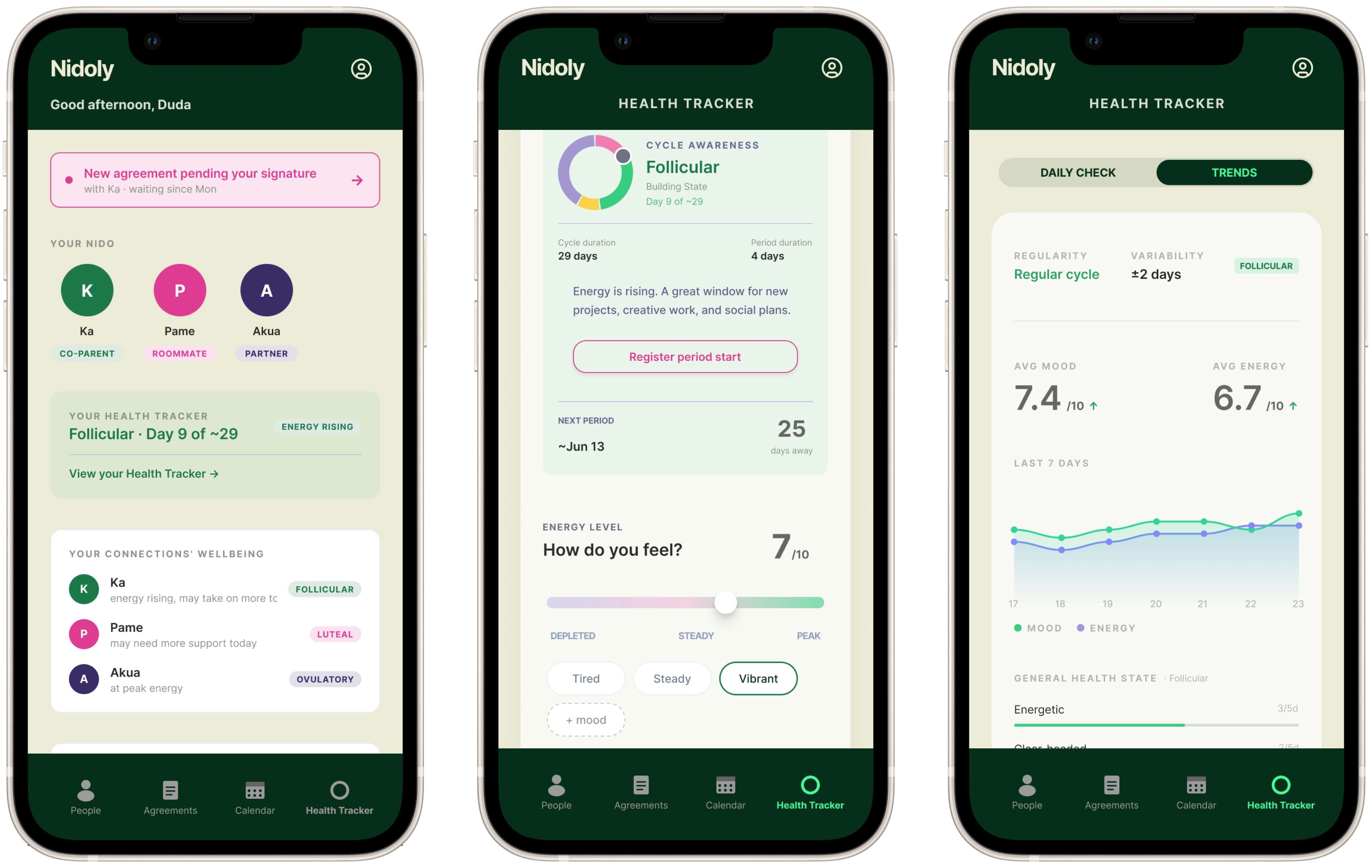
Nidoly is not a productivity app, a calendar, or a task manager. It's a platform built around agreements between people who share responsibilities: co-parents, housemates, patchwork families, blended households, anyone who needs those agreements to actually hold up over time.

The platform combines three things that work together: an agreements log that records what people decide, an integrated calendar, and a health tracker that surfaces capacity. The agreements log is the foundation. The calendar and health tracker exist to support it.

This is a project I co-founded. That means I've made UX decisions under startup constraints, with real users, on a product I believe in, and it means I've had to navigate the tension between what's right for users and what's feasible for a two-person team with limited resources.

The Problem

When people share a home, a child, or a life, they don't run on contracts. They run on conversations and memory: who said they'd do what, when, and under what conditions. The problem is that conversations don't hold. Months later, two people remember the same agreement differently, not because either is lying, but because memory isn't built to store this kind of detail reliably.

Responsibilities also don't stay fixed. They evolve as life changes, and capacity changes with them: someone's bandwidth this month isn't their bandwidth next month. Without a shared source of truth that both people can point back to, there's nothing to resolve the gap between what was agreed and what's remembered, or between what someone could take on and what they currently can.

Tools that already exist for this focus on couples or traditional households. Nidoly is built for the relationships those tools leave out.
Research

I ran five qualitative interviews before building. I went in assuming the product was for people in romantic relationships. The research corrected me.

What I heard:

"I have strong period pain for more than one week and feel unable to do basic things at home like cleaning."

"I live with many people and despite our regular meetings, I always have to remind some of them to do tasks and how to do it properly."

"My ex-partner thinks we share half/half of the responsibility with our kid, but I am the person who organizes everything."

"It's frustrating that in arguments people say they don't remember having said something in the past."

The Pivot

The original model was built around romantic relationships. The research made clear that framing was too narrow — and that by keeping it, we'd exclude the people who needed the product most: those in non-conventional, non-formal care networks that existing tools were never designed to serve.

One participant put it simply:

"I don't have a romantic relationship right now, but I do have relationships — and we do need commitment."

We restructured the product around shared responsibility relationships rather than romantic ones. This changed onboarding, user flows, and how we describe the product.

Status & What's Next

Nidoly is in the final stage before pilot launch. The pilot is designed to answer:

Whether the Agreements Log gets used as a living reference during real disagreements, or whether it's the kind of feature people set up once and never open again.

One tension shaped a lot of the decisions along the way: the feature people got most excited about in interviews, the Health Tracker, wasn't the same feature that actually solved the core problem, the Agreements Log. It would have been easy to let the more exciting feature pull focus. Keeping the Agreements Log as the foundation, even when it wasn't the thing generating the most enthusiasm in the room, was a deliberate call.

What I'd do differently:

As a co-founder, it's hard to separate personal conviction from validated user demand. I'd be more upfront, earlier, about which decisions were research-backed and which were ones I just believed in — the pilot is partly how I'm forcing myself to find out which is which.

Design Decisions

01 — The Agreements Log

The Agreements Log is the foundation of the product, and the feature the rest of Nidoly is built to support. Two people create an agreement together: who is responsible for what, under what conditions, starting when. Once both sides confirm it, each person adds a symbolic signature. It isn't a legal signature and it doesn't hold up in any formal sense. It's a deliberate marker that says I saw this and I agreed to it, which is the level of accountability the product is actually trying to create.

When an agreement is created or changed, both participants are notified, so no one finds out about a shift in responsibilities after the fact. And because responsibilities evolve, agreements need to evolve too: editing an existing agreement doesn't overwrite what came before. It creates a new version and keeps the old one in the log, so the history stays intact and no one can quietly rewrite what was agreed.

This is the core design decision behind the whole product: accountability, not enforcement. Nidoly doesn't try to make people follow through on agreements. It tries to make sure no one has to rely on memory to know what was agreed in the first place.

02 — The Health Tracker

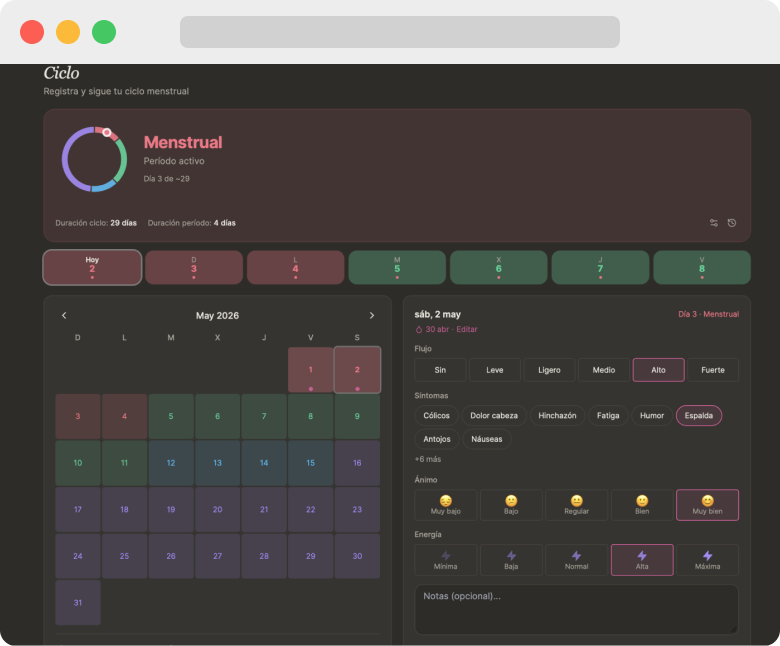
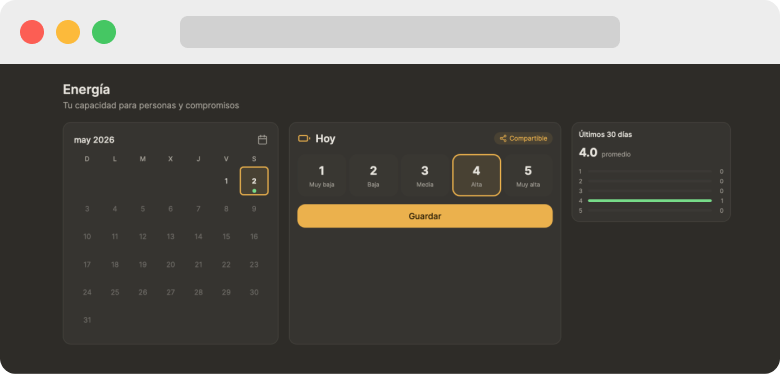
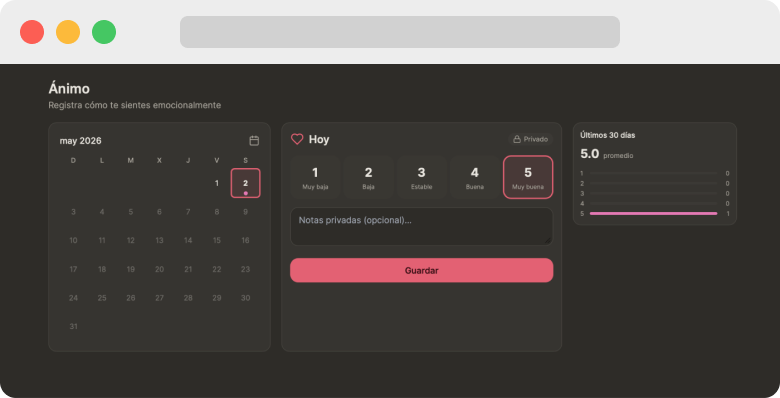
3 SEPARATE FEATURES (BEFORE)

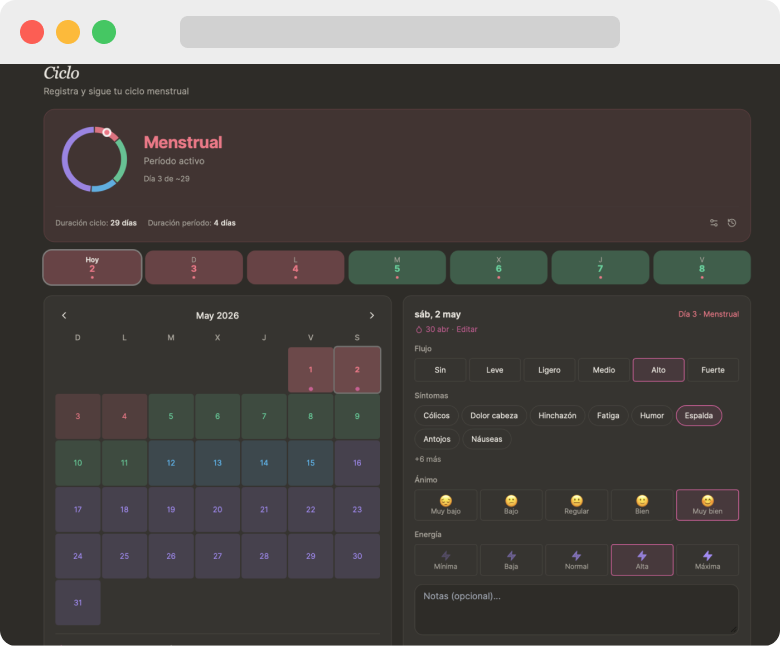
UNIFIED HEALTH TRACKER (AFTER)

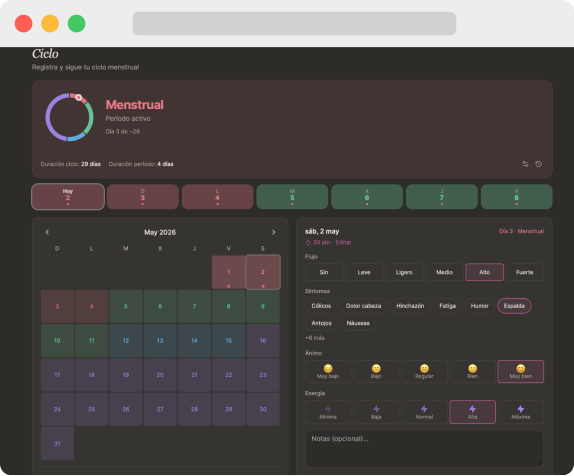
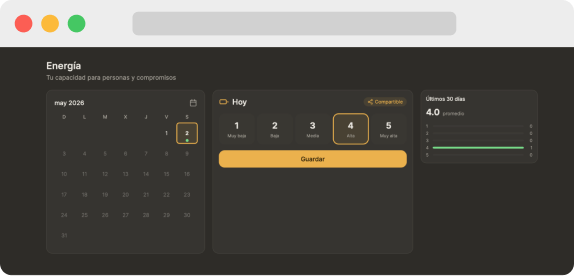
The before screens are in Spanish — the co-founders’ shared working language when Nidoly was first built. As the product became bilingual, the design was also redesigned. The after shows the unified Health Tracker in English.

Early versions had three separate features: an energy tracker, a mood tracker, and a menstrual cycle tracker. Users had to navigate between them to understand how they were feeling, even though the three signals are deeply related: cycle phase affects energy, energy affects mood. Separating them created cognitive work the product should have been absorbing, so they were unified into one Health Tracker.

The reason this feature matters isn't just usability. Research showed that people's capacity to take on responsibilities genuinely changes day to day and week to week, and that capacity is exactly what an informal agreement loses track of. The Health Tracker makes that visible instead of assumed, and it was consistently the feature participants got most excited about in interviews.

That excitement is real, but it doesn't change what the product is. The Health Tracker gives people the context to renegotiate fairly. The Agreements Log is still where that renegotiation actually gets recorded and held.

03 — The Menstrual Cycle Tracker as a Fairness Mechanism

Including it wasn't just a feature decision — it was a design argument: equitable agreements require empathy, and empathy requires visibility. If the people you share a home with can see that you're in a low-energy phase of your cycle, they have context to redistribute tasks without you having to ask, explain, or justify yourself.

Making this visible by default is a form of structural empathy — designed into the product rather than left to individual negotiation. No existing shared-responsibility tool does this.

Constraints

We are a two-person team. The biggest design constraints are time and money: we can't run multiple research iterations, and the product evolves more slowly than I'd like.

Those constraints sharpened our prioritization. Every design decision had to carry enough confidence to build on. The Health Tracker consolidation is partly a product of this — one coherent feature is worth more than three fragmented ones that would each need future work.

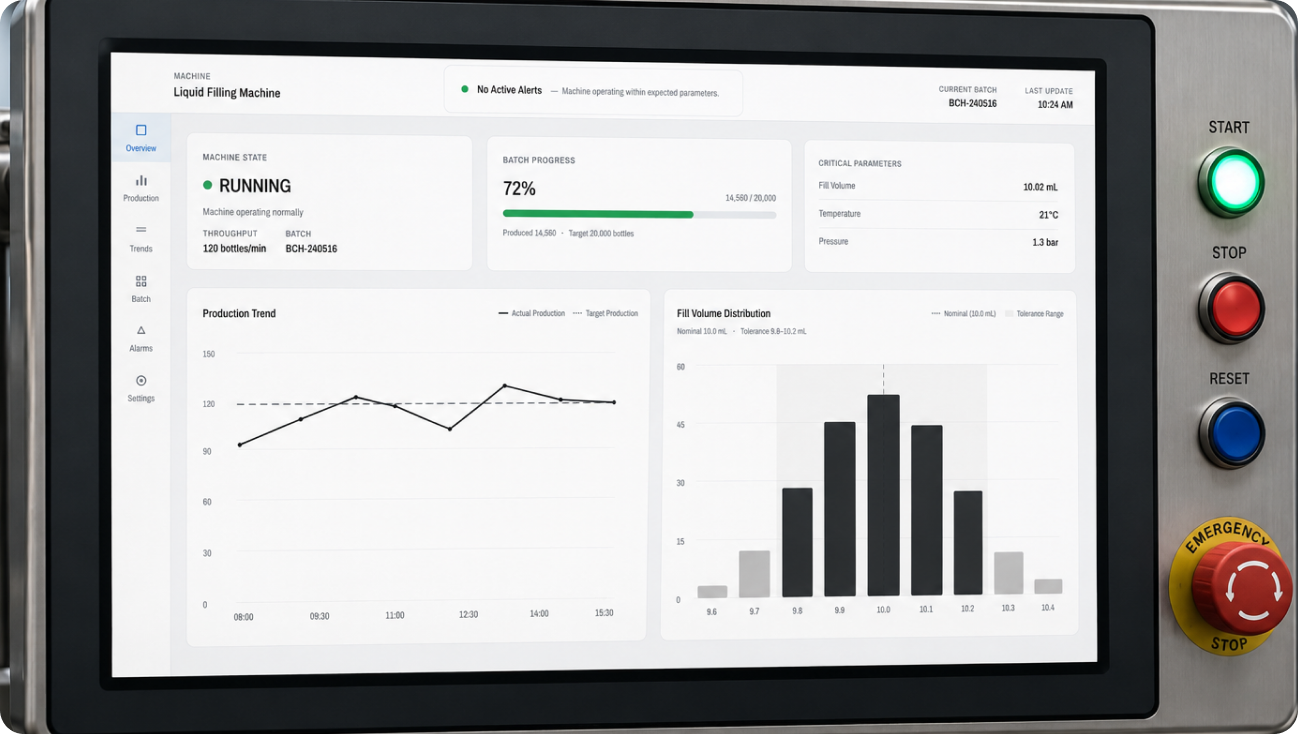
INDUSTRIAL UX · NDA, SANITIZED

Industrial HMI

PRODUCT · CO-RESPONSABILITY TOOL

Nidoly

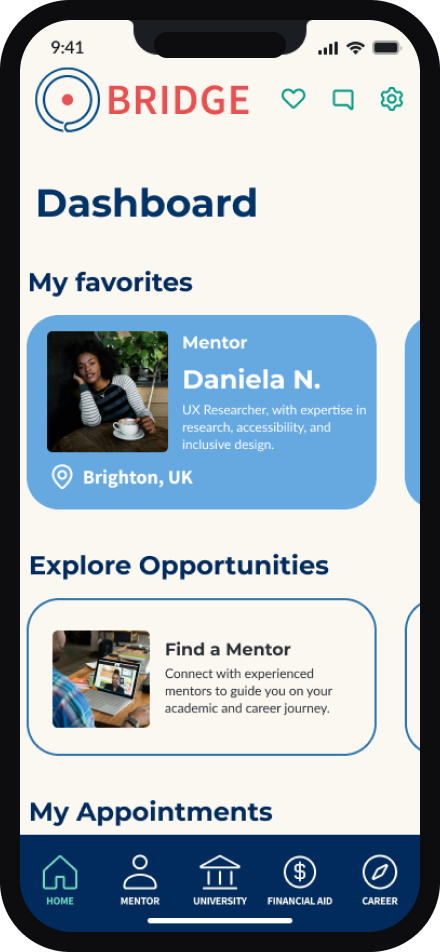
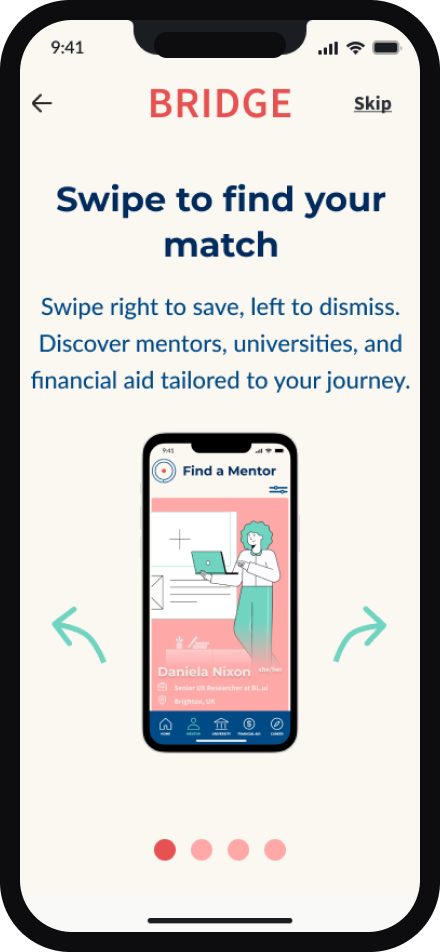
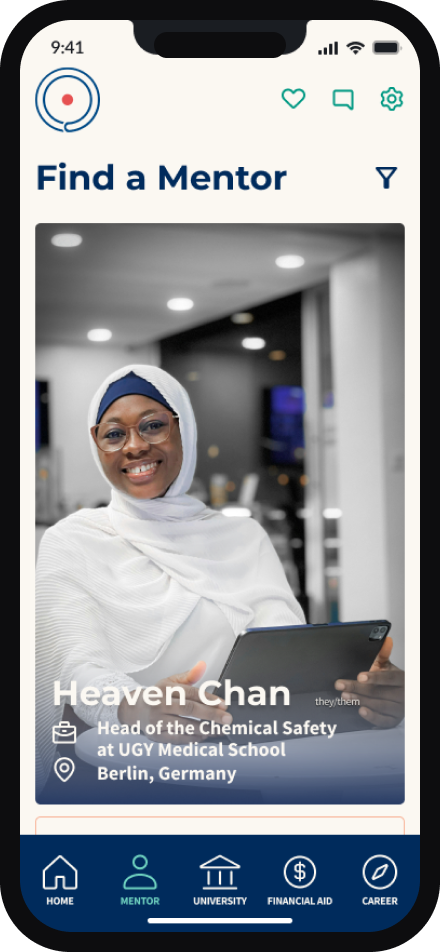
UX RESEARCH · MENTORSHIP APP

BRIDGE

Let’s work together

© 2026

Home

Work

About

Eduarda Freire

Nidoly

A UX/UI case study by Eduarda Freire

  • Role

  • Co-founder & UX Lead

  • Timeline

  • Feb 2026 – ongoing

  • Team

  • 2 people

  • Status

  • Pilot launch

Nidoly is not a productivity app, a calendar, or a task manager. It's a platform built around agreements between people who share responsibilities: co-parents, housemates, patchwork families, blended households, anyone who needs those agreements to actually hold up over time.

The platform combines three things that work together: an agreements log that records what people decide, an integrated calendar, and a health tracker that surfaces capacity. The agreements log is the foundation. The calendar and health tracker exist to support it.

This is a project I co-founded. That means I've made UX decisions under startup constraints, with real users, on a product I believe in, and it means I've had to navigate the tension between what's right for users and what's feasible for a two-person team with limited resources.

The Problem

When people share a home, a child, or a life, they don't run on contracts. They run on conversations and memory: who said they'd do what, when, and under what conditions. The problem is that conversations don't hold. Months later, two people remember the same agreement differently, not because either is lying, but because memory isn't built to store this kind of detail reliably.

Responsibilities also don't stay fixed. They evolve as life changes, and capacity changes with them: someone's bandwidth this month isn't their bandwidth next month. Without a shared source of truth that both people can point back to, there's nothing to resolve the gap between what was agreed and what's remembered, or between what someone could take on and what they currently can.

Tools that already exist for this focus on couples or traditional households. Nidoly is built for the relationships those tools leave out.
Research

I ran five qualitative interviews before building. I went in assuming the product was for people in romantic relationships. The research corrected me.

What I heard:

"I have strong period pain for more than one week and feel unable to do basic things at home like cleaning."

"I live with many people and despite our regular meetings, I always have to remind some of them to do tasks and how to do it properly."

"My ex-partner thinks we share half/half of the responsibility with our kid, but I am the person who organizes everything."

"It's frustrating that in arguments people say they don't remember having said something in the past."

The Pivot

The original model was built around romantic relationships. The research made clear that framing was too narrow — and that by keeping it, we'd exclude the people who needed the product most: those in non-conventional, non-formal care networks that existing tools were never designed to serve.

One participant put it simply:

"I don't have a romantic relationship right now, but I do have relationships — and we do need commitment."

We restructured the product around shared responsibility relationships rather than romantic ones. This changed onboarding, user flows, and how we describe the product.

Design Decisions

01 — The Agreements Log

The Agreements Log is the foundation of the product, and the feature the rest of Nidoly is built to support. Two people create an agreement together: who is responsible for what, under what conditions, starting when. Once both sides confirm it, each person adds a symbolic signature. It isn't a legal signature and it doesn't hold up in any formal sense. It's a deliberate marker that says I saw this and I agreed to it, which is the level of accountability the product is actually trying to create.

When an agreement is created or changed, both participants are notified, so no one finds out about a shift in responsibilities after the fact. And because responsibilities evolve, agreements need to evolve too: editing an existing agreement doesn't overwrite what came before. It creates a new version and keeps the old one in the log, so the history stays intact and no one can quietly rewrite what was agreed.

This is the core design decision behind the whole product: accountability, not enforcement. Nidoly doesn't try to make people follow through on agreements. It tries to make sure no one has to rely on memory to know what was agreed in the first place.

02 — The Health Tracker

3 SEPARATE FEATURES (BEFORE)

UNIFIED HEALTH TRACKER (AFTER)

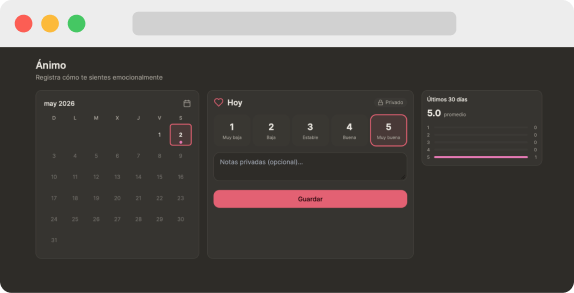
The before screens are in Spanish — the co-founders’ shared working language when Nidoly was first built. As the product became bilingual, the design was also redesigned. The after shows the unified Health Tracker in English.

Early versions had three separate features: an energy tracker, a mood tracker, and a menstrual cycle tracker. Users had to navigate between them to understand how they were feeling, even though the three signals are deeply related: cycle phase affects energy, energy affects mood. Separating them created cognitive work the product should have been absorbing, so they were unified into one Health Tracker.

The reason this feature matters isn't just usability. Research showed that people's capacity to take on responsibilities genuinely changes day to day and week to week, and that capacity is exactly what an informal agreement loses track of. The Health Tracker makes that visible instead of assumed, and it was consistently the feature participants got most excited about in interviews.

That excitement is real, but it doesn't change what the product is. The Health Tracker gives people the context to renegotiate fairly. The Agreements Log is still where that renegotiation actually gets recorded and held.

03 — The Menstrual Cycle Tracker as a Fairness Mechanism

Including it wasn't just a feature decision — it was a design argument: equitable agreements require empathy, and empathy requires visibility. If the people you share a home with can see that you're in a low-energy phase of your cycle, they have context to redistribute tasks without you having to ask, explain, or justify yourself.

Making this visible by default is a form of structural empathy — designed into the product rather than left to individual negotiation. No existing shared-responsibility tool does this.

Constraints

We are a two-person team. The biggest design constraints are time and money: we can't run multiple research iterations, and the product evolves more slowly than I'd like.

Those constraints sharpened our prioritization. Every design decision had to carry enough confidence to build on. The Health Tracker consolidation is partly a product of this — one coherent feature is worth more than three fragmented ones that would each need future work.

Status & What's Next

Nidoly is in the final stage before pilot launch. The pilot is designed to answer:

Whether the Agreements Log gets used as a living reference during real disagreements, or whether it's the kind of feature people set up once and never open again.

One tension shaped a lot of the decisions along the way: the feature people got most excited about in interviews, the Health Tracker, wasn't the same feature that actually solved the core problem, the Agreements Log. It would have been easy to let the more exciting feature pull focus. Keeping the Agreements Log as the foundation, even when it wasn't the thing generating the most enthusiasm in the room, was a deliberate call.

What I'd do differently:

As a co-founder, it's hard to separate personal conviction from validated user demand. I'd be more upfront, earlier, about which decisions were research-backed and which were ones I just believed in — the pilot is partly how I'm forcing myself to find out which is which.

INDUSTRIAL UX · NDA, SANITIZED

Industrial HMI

PRODUCT · CO-RESPONSABILITY TOOL

Nidoly

UX RESEARCH · MENTORSHIP APP

BRIDGE

Let’s work together

© 2026

Home

Work

About

Eduarda Freire

Nidoly

A UX/UI case study by Eduarda Freire

  • Role

  • Co-founder & UX Lead

  • Timeline

  • Feb 2026 – ongoing

  • Team

  • 2 people

  • Status

  • Pilot launch

Nidoly is not a productivity app, a calendar, or a task manager. It's a platform built around agreements between people who share responsibilities: co-parents, housemates, patchwork families, blended households, anyone who needs those agreements to actually hold up over time.

The platform combines three things that work together: an agreements log that records what people decide, an integrated calendar, and a health tracker that surfaces capacity. The agreements log is the foundation. The calendar and health tracker exist to support it.

This is a project I co-founded. That means I've made UX decisions under startup constraints, with real users, on a product I believe in, and it means I've had to navigate the tension between what's right for users and what's feasible for a two-person team with limited resources.

The Problem

When people share a home, a child, or a life, they don't run on contracts. They run on conversations and memory: who said they'd do what, when, and under what conditions. The problem is that conversations don't hold. Months later, two people remember the same agreement differently, not because either is lying, but because memory isn't built to store this kind of detail reliably.

Responsibilities also don't stay fixed. They evolve as life changes, and capacity changes with them: someone's bandwidth this month isn't their bandwidth next month. Without a shared source of truth that both people can point back to, there's nothing to resolve the gap between what was agreed and what's remembered, or between what someone could take on and what they currently can.

Tools that already exist for this focus on couples or traditional households. Nidoly is built for the relationships those tools leave out.
Research

I ran five qualitative interviews before building. I went in assuming the product was for people in romantic relationships. The research corrected me.

What I heard:

"I have strong period pain for more than one week and feel unable to do basic things at home like cleaning."

"I live with many people and despite our regular meetings, I always have to remind some of them to do tasks and how to do it properly."

"My ex-partner thinks we share half/half of the responsibility with our kid, but I am the person who organizes everything."

"It's frustrating that in arguments people say they don't remember having said something in the past."

The Pivot

The original model was built around romantic relationships. The research made clear that framing was too narrow — and that by keeping it, we'd exclude the people who needed the product most: those in non-conventional, non-formal care networks that existing tools were never designed to serve.

One participant put it simply:

"I don't have a romantic relationship right now, but I do have relationships — and we do need commitment."

We restructured the product around shared responsibility relationships rather than romantic ones. This changed onboarding, user flows, and how we describe the product.

Design Decisions

01 — The Agreements Log

The Agreements Log is the foundation of the product, and the feature the rest of Nidoly is built to support. Two people create an agreement together: who is responsible for what, under what conditions, starting when. Once both sides confirm it, each person adds a symbolic signature. It isn't a legal signature and it doesn't hold up in any formal sense. It's a deliberate marker that says I saw this and I agreed to it, which is the level of accountability the product is actually trying to create.

When an agreement is created or changed, both participants are notified, so no one finds out about a shift in responsibilities after the fact. And because responsibilities evolve, agreements need to evolve too: editing an existing agreement doesn't overwrite what came before. It creates a new version and keeps the old one in the log, so the history stays intact and no one can quietly rewrite what was agreed.

This is the core design decision behind the whole product: accountability, not enforcement. Nidoly doesn't try to make people follow through on agreements. It tries to make sure no one has to rely on memory to know what was agreed in the first place.

02 — The Health Tracker

3 SEPARATE FEATURES (BEFORE)

UNIFIED HEALTH TRACKER (AFTER)

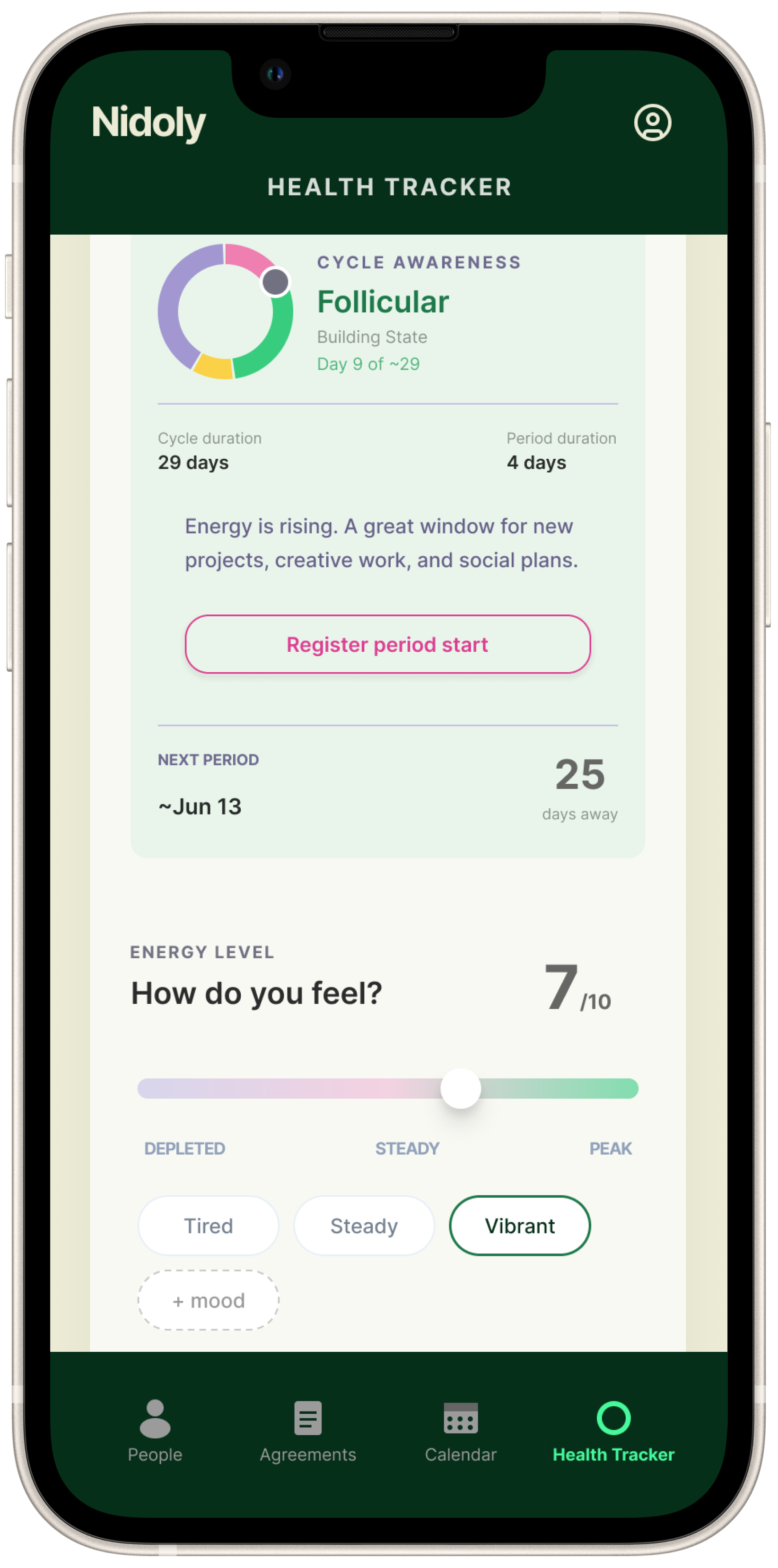
The before screens are in Spanish — the co-founders’ shared working language when Nidoly was first built. As the product became bilingual, the design was also redesigned. The after shows the unified Health Tracker in English.

Early versions had three separate features: an energy tracker, a mood tracker, and a menstrual cycle tracker. Users had to navigate between them to understand how they were feeling, even though the three signals are deeply related: cycle phase affects energy, energy affects mood. Separating them created cognitive work the product should have been absorbing, so they were unified into one Health Tracker.

The reason this feature matters isn't just usability. Research showed that people's capacity to take on responsibilities genuinely changes day to day and week to week, and that capacity is exactly what an informal agreement loses track of. The Health Tracker makes that visible instead of assumed, and it was consistently the feature participants got most excited about in interviews.

That excitement is real, but it doesn't change what the product is. The Health Tracker gives people the context to renegotiate fairly. The Agreements Log is still where that renegotiation actually gets recorded and held.

03 — The Menstrual Cycle Tracker as a Fairness Mechanism

Including it wasn't just a feature decision — it was a design argument: equitable agreements require empathy, and empathy requires visibility. If the people you share a home with can see that you're in a low-energy phase of your cycle, they have context to redistribute tasks without you having to ask, explain, or justify yourself.

Making this visible by default is a form of structural empathy — designed into the product rather than left to individual negotiation. No existing shared-responsibility tool does this.

Constraints

We are a two-person team. The biggest design constraints are time and money: we can't run multiple research iterations, and the product evolves more slowly than I'd like.

Those constraints sharpened our prioritization. Every design decision had to carry enough confidence to build on. The Health Tracker consolidation is partly a product of this — one coherent feature is worth more than three fragmented ones that would each need future work.

Status & What's Next

Nidoly is in the final stage before pilot launch. The pilot is designed to answer:

Whether the Agreements Log gets used as a living reference during real disagreements, or whether it's the kind of feature people set up once and never open again.

One tension shaped a lot of the decisions along the way: the feature people got most excited about in interviews, the Health Tracker, wasn't the same feature that actually solved the core problem, the Agreements Log. It would have been easy to let the more exciting feature pull focus. Keeping the Agreements Log as the foundation, even when it wasn't the thing generating the most enthusiasm in the room, was a deliberate call.

What I'd do differently:

As a co-founder, it's hard to separate personal conviction from validated user demand. I'd be more upfront, earlier, about which decisions were research-backed and which were ones I just believed in — the pilot is partly how I'm forcing myself to find out which is which.

INDUSTRIAL UX · NDA, SANITIZED

Industrial HMI

PRODUCT · CO-RESPONSABILITY TOOL

Nidoly

UX RESEARCH · MENTORSHIP APP

BRIDGE

Let’s work together